6/3/14

Among the towering red dunes of Namib-Naukluft National Park in the central Namib Desert is an area known as Sossusvlei. It is a strange and alien landscape. The rich red dunes that surround the area owe their hue to age -- over the thousands of years, the sand has literally rusted.
Sossusvlei is a wide, flat, salt-covered expanse with a dense and compact layer of clay in the subsoil. When dry, Sossusvlei is hard and arid, and when wet, as it gets every 5-10 years when fed by the Tsauchab River, it becomes sticky and plastic. The area is the river's final destination. Even in the wettest of years, the water soaks into the salt/clay pan, giving the area its nickname: "place of no return." Altogether the blue sky, red dunes, and white pans make a striking vision, reminiscent of movies such as "The Fall," "The Cell," and "Steel Dawn."
Nearby is yet another "place of no return" this one even older, and much more dead than Sossusvlei. Known as Dead Vlei or "dead marsh" (Vlei being Afrikaans for a type of marsh), it is found among the tallest dunes in the world -- some reach 1,312 feet high, which is almost as lofty as the Empire State Building. Dead Vlei was once like Sossusvlei, with the river draining into it nourishing desert life and even trees. But no longer. Some 900 years ago the climate dried up, and dunes cut off Dead Vlei from the river.


Grand Prismatic is the largest hot spring in Yellowstone, and is considered to be the third largest in the world-New Zealand has the two largest springs. Grand Prismatic sits upon a wide, spreading mound where water flows evenly on all sides forming a series of small, stair-step terraces. The Hayden Expedition in 1871 named this spring because of its beautiful coloration, and artist Thomas Moran made water-color sketches depicting its rainbow-like colors. The sketches seemed exaggerations and geologist A.C. Peale returned in 1878 to verify the colors. The colors begin with a deep blue center followed by pale blue. Green algae forms beyond the shallow edge. Outside the scalloped rim a band of yellow fades into orange. Red then marks the outer border. Steam often shrouds the spring which reflects the brilliant colors. Grand Prismatic discharges an estimated 560 gallons per minute.


6/2/14

With January being possibly one of the most uninspiring months on the English calendar, it's quite nice to cheer yourself up with stunning pictures of incredible natural phenomena in exotic far-off lands.
So, we thought we'd share these amazing photos of bioluminescence (the production and emission of light by a living organism), in this case also prettily known as the Sea of Stars, occurring at night on the island of Vaadhoo in the Maldives.
The breathtaking phenomenon is caused when dinoflagellates, a species of plankton, emit a bright blue light as their cell membranes respond to electrical signals and glow.It is a common occurrence on the Vaadhoo island, which is an inhabited island in the Raa Atoll.


Bigar waterfall is a waterfall that is very beautiful with green moss on the tour by a very wonderful and under there is the Mini. This waterfall is located in the Caraș county western part of Severin Romania. Bigar waterfall or as the locals call it the miracle of Canyon minis and Coronini which is part of The Minis. and one of Romania’s largest waterfall, waterfall is very unique with water dispersed and falls, this waterfall is located in the mountains of Anina, with underground river that passes through the cave and then get out. About 200 yards and spread to the falls are very pretty. Water here is very much like rich limestone to The Mini through the Rocky thresholds. Height of the waterfall is about 8 meters with the cover layer of moss green and very special.


6/1/14

Antelope Canyon is the most-visited and most-photographed slot canyon in the American Southwest. It is located on Navajo land near Page, Arizona. Antelope Canyon includes two separate, photogenic slot canyon sections, referred to individually as Upper Antelope Canyon or The Crack; and Lower Antelope Canyon or The Corkscrew. Upper Antelope Canyon is called Tsé bighánílíní, "the place where water runs through rocks" by the Navajo. It is the most frequently visited by tourists, due to two considerations. First, its entrance and entire length are at ground level, requiring no climbing. Second, beams (shafts of direct sunlight radiating down from openings in the top of the canyon) are much more common in Upper than in Lower. Beams occur most often in the summer months, as they require the sun to be high in the sky. Winter colors are a little more muted like the photo displayed here. Summer months provide two types of lighting. Light beams start to peek into the canyon March 15 and disappear October 7 each year. Antelope Canyon is a popular location for photographers and sightseers, and a source of tourism business for the Navajo Nation. It has been accessible by permit only since 1997, when the Navajo Tribe made it a Navajo Tribal Park. Photography within the canyons is difficult due to the wide exposure range (often 10 EV or more) made by light reflecting off the canyon walls. Entry to Antelope Canyon is restricted to guided tours led by authorized guides.
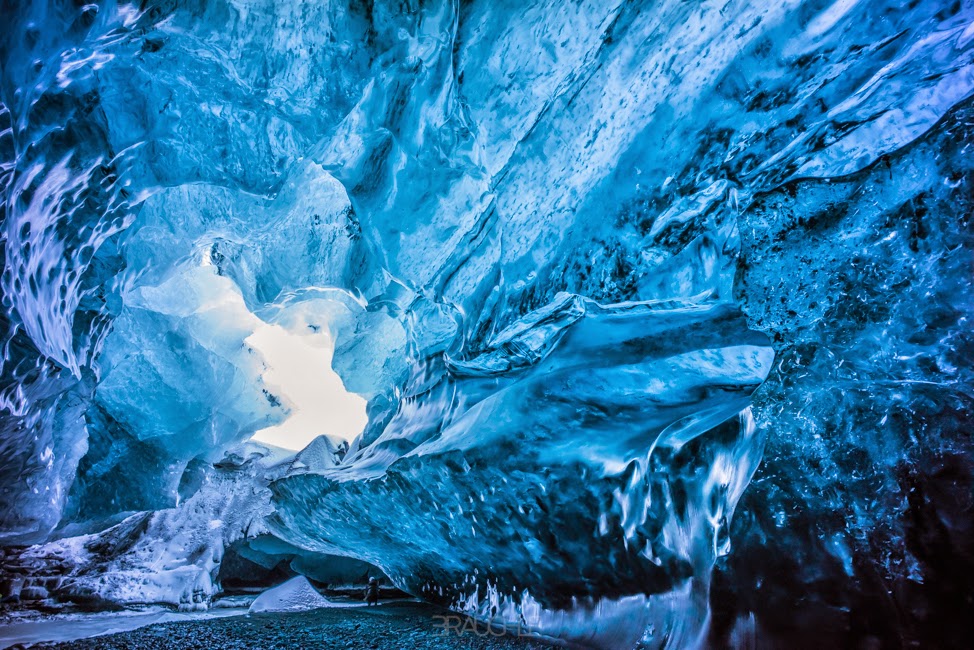


For such a small country--and one with a less than enticing name--Iceland sure has its fair share of must-see natural phenomena. If you've already soaked up the steamy minerals of the Blue Lagoon, head southeast to Skaftafell, a preservation area that has been incorporated into Vatnajokull National Park, largely for its jaw-dropping glacial contents, which are highlighted by the Crystal Cave of Svmnafellsjvkull.

Created by the unparalleled forces of the Vatnajvkull ice cap, the Crystal Cave emerged as a result of its glacier meeting the Icelandic coastline. The cave's ice dates back centuries, and its weight has pressed out all remnant air, so the resultant formation's texture and colors are both brilliant and otherworldly. Access is via a 22-foot entrance at the water's edge, though height clearance tapers down to only about 4 feet at the far end, about 150 feet in.